
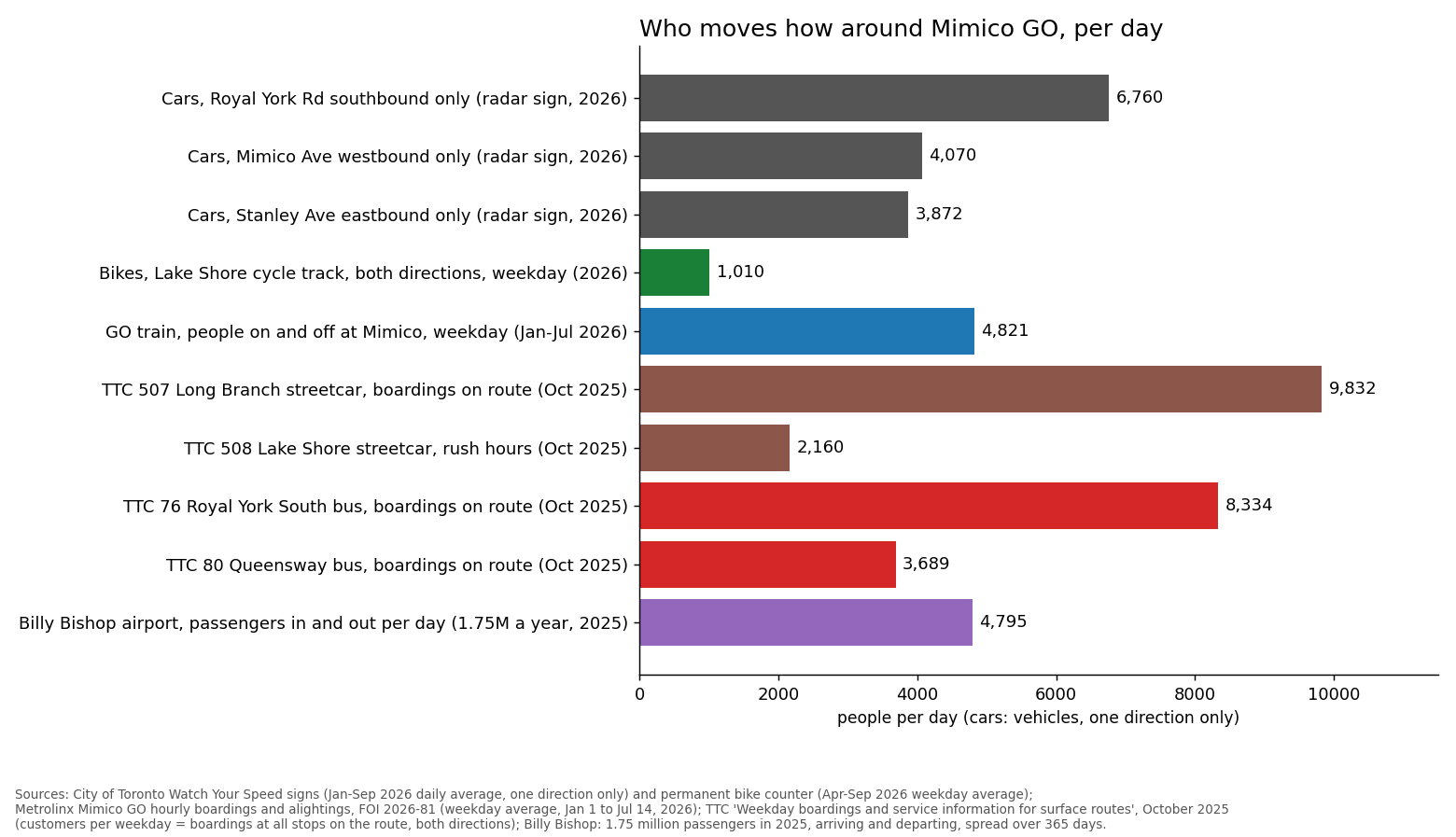
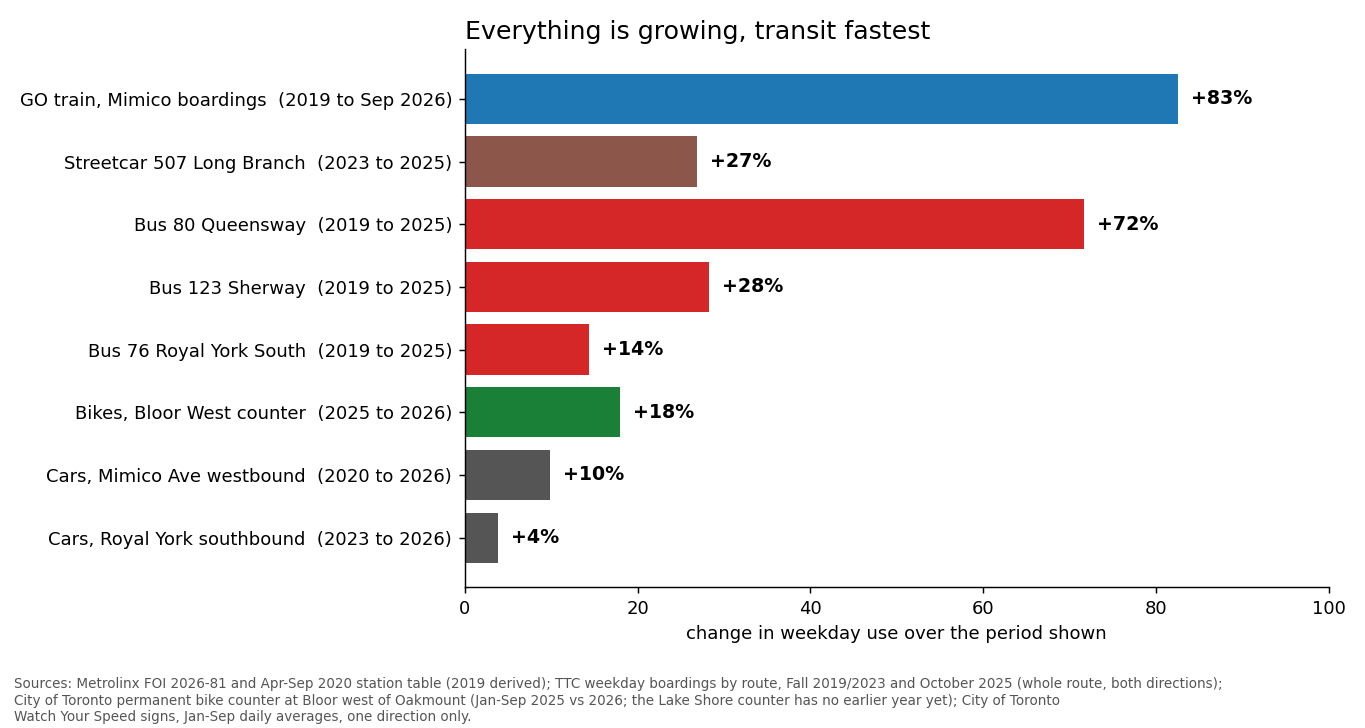
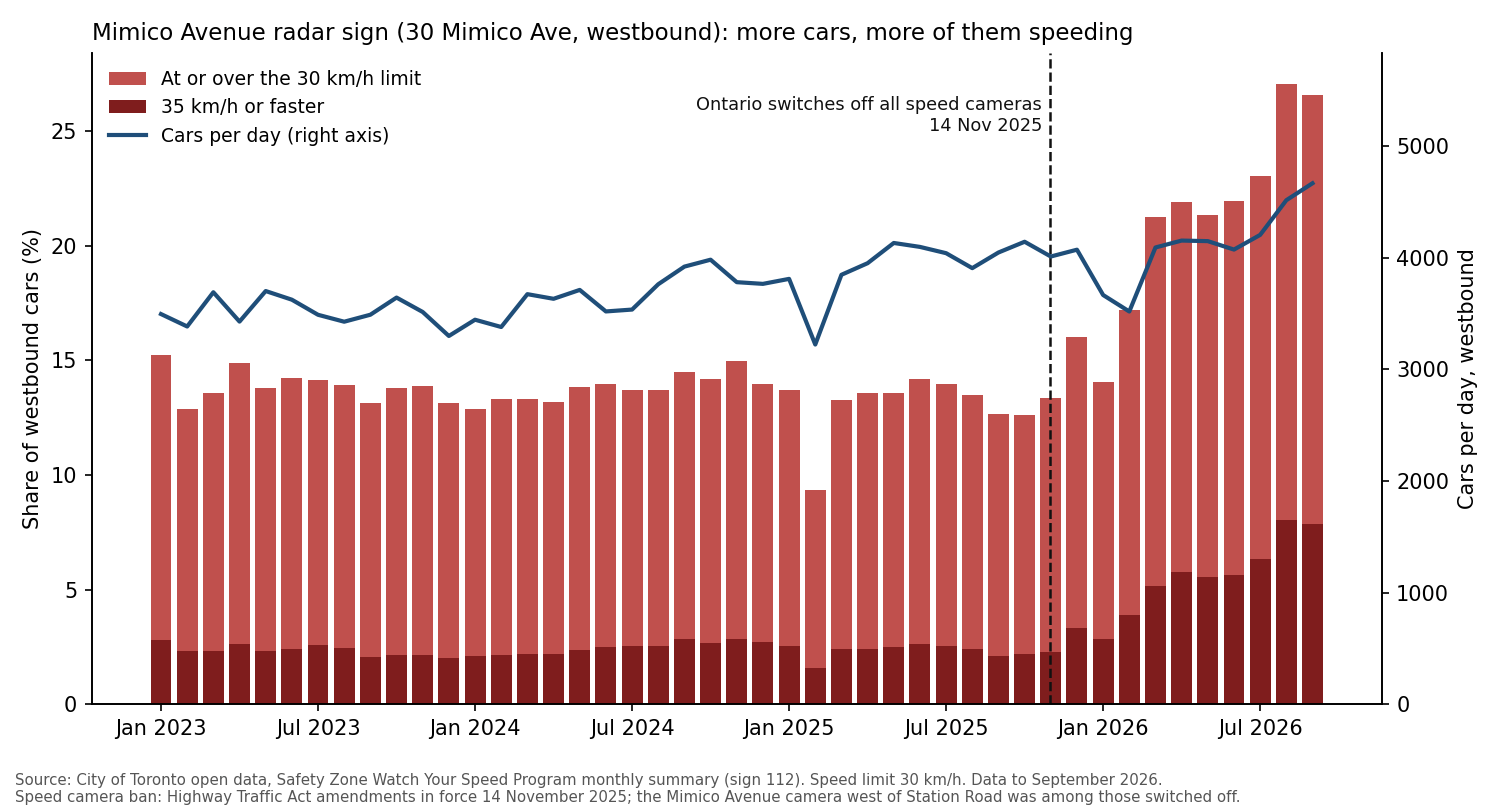
There are more cars than ever driving through Mimico. The City’s radar sign on Mimico Avenue counted about 4,070 cars a day heading west this year, up 17 per cent on three years ago and the most since the sign went up in 2019.
How more cars are invited
-
Ontario Place. A provincial parking garage for up to 3,500 cars, costing taxpayers $200 million to build, and expected to collect up to $60 million a year from drivers. Lake Shore peak traffic is expected to go up to 67 per cent above what it would otherwise be. This study is from before the size of the parkade got almost doubled to 3,500 spaces. We mentioned this forecast in 2025.
-
Mississauga’s Lakeview: 16,000 homes next door. Mississauga’s own study for the old power-plant site covered about 9,700 homes and forecast about 4,300 new car
trips in the evening rush. In May 2023 the province raised the cap to 16,000 homes by minister’s zoning order (MZO) at the developers’ request, and no traffic study
of the larger number had been done when the order was signed. Homes planned around the car, Long Branch GO too far to walk, and Lake Shore as the direct road
downtown are an invitation to drive.
-
Parking in the new towers. Every additional parking space is an invitation for an additional car. The over a dozen live applications around Mimico GO propose about 10,000 new homes with about 4,000 new parking spaces. That’s about the same amount of cars that already go up Mimico Ave every day.
How people are kept off transit
-
No barrier-free access to the GO train. Mimico is the last GO station without a step-free route under construction. Every parent with a stroller, every senior with a walker, every traveller with a suitcase and every rider with a bad knee is pushed towards using a car. Metrolinx promised a tunnel with elevators for 2016. Ten years later it is designing a bridge instead and has not said when it will be done.
-
No 15-minute GO train service at rush hour. Metrolinx told us in writing that “infrastructure constraints … currently limit scheduling possibilities at this station.” Riders tell us rush hour trains arrive full. Standing for 16 minutes to get to Union is a reason for some to Uber instead.
-
A streetcar in the traffic. The 507 Long Branch shares Lake Shore with increasing numbers of cars, so when the road fills up, the streetcar slows with it.
-
A bus in the traffic. The 76 Royal York South is Mimico’s only surface link to the Line 2 subway, and it already carries about 8,300 riders a day, up 14 per
cent since 2019. It queues up Royal York with everyone else at busy times, and with one lane each way there is no room for a bus lane. More cars on Royal York
and Lake Shore mean slower trips on the 76, the 501 and the 507 for all of south Etobicoke.
Every one of these is a barrier, and barriers count double. Transport economists value a minute spent waiting, climbing stairs or changing from one transit vehicle to another at twice a minute spent on board. Transit competes with the car on steps, minutes, cost and convenience.
Every step creates a barrier
Accessibility at a train station comes down to stairs. With a tunnel, you walk down one flight, under the tracks, and up one flight to the platform. With a bridge, you climb over the trains and over the overhead electric wires planned for GO Expansion, then all the way back down: four to five flights up, and the same down, on each side. Metrolinx’s own station design standard says tunnels “provide shorter, more direct routes with less vertical travel, making them quicker and more accessible.” That matters most on the days an elevator is out of service and you have a child in a stroller.
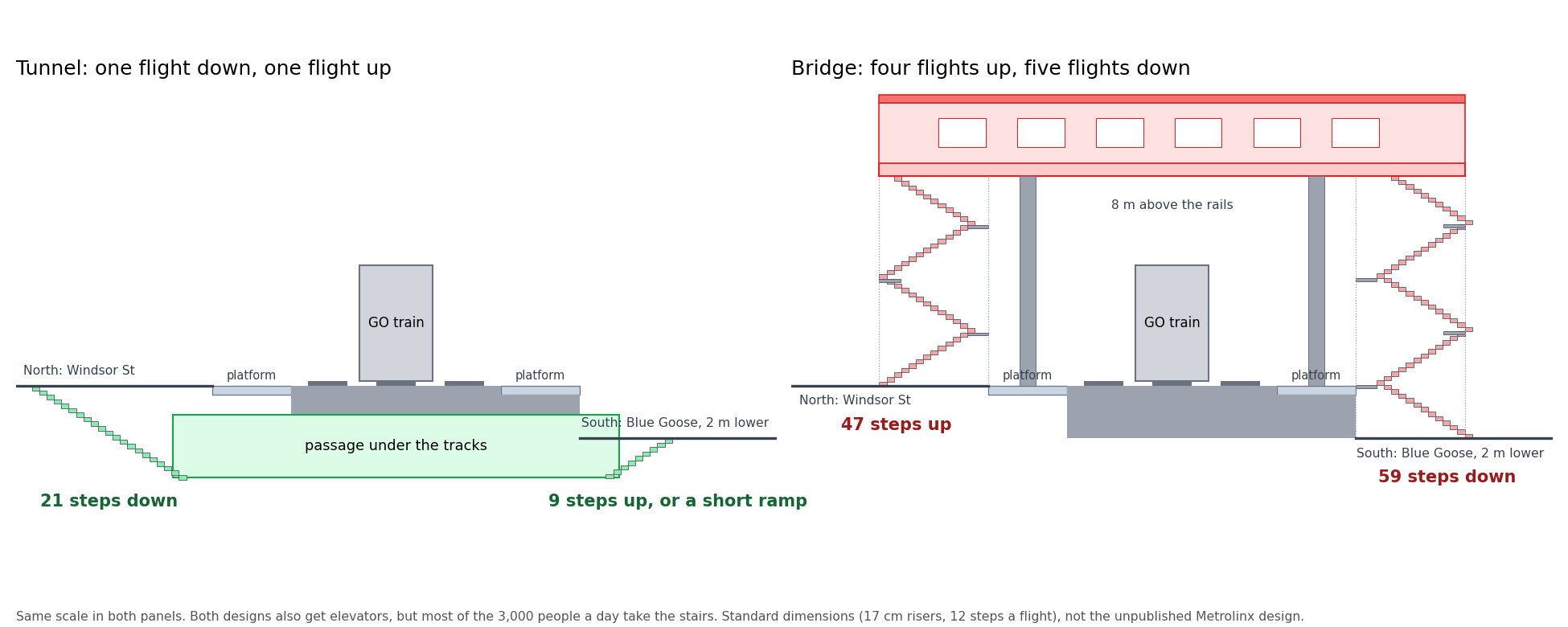
Metrolinx told us in August that one of the reasons for the bridge is that it “provides more opportunities for potential future Transit Oriented Communities (TOC) connections and integration with adjacent properties.”
Long Branch, one stop west, is getting a tunnel with elevators. Both stations were in the same Metrolinx procurement: a request for qualifications in December 2017 and a request for proposals in April 2018. Mimico is getting a bridge.
It is not just a lack of accessibility we are dealing with at Mimico GO. It is also a lack of transparency and, after more than ten years of missed deadlines, a lack of accountability.
The demand for transit is already here
Metrolinx used to publish station-by-station ridership on its open data page; the last map it posted covers April to September 2020, and the page now lists the ridership report as “archived”.
So a Mimico resident filed, and paid for, a freedom of information request this summer, and the records arrived this week.
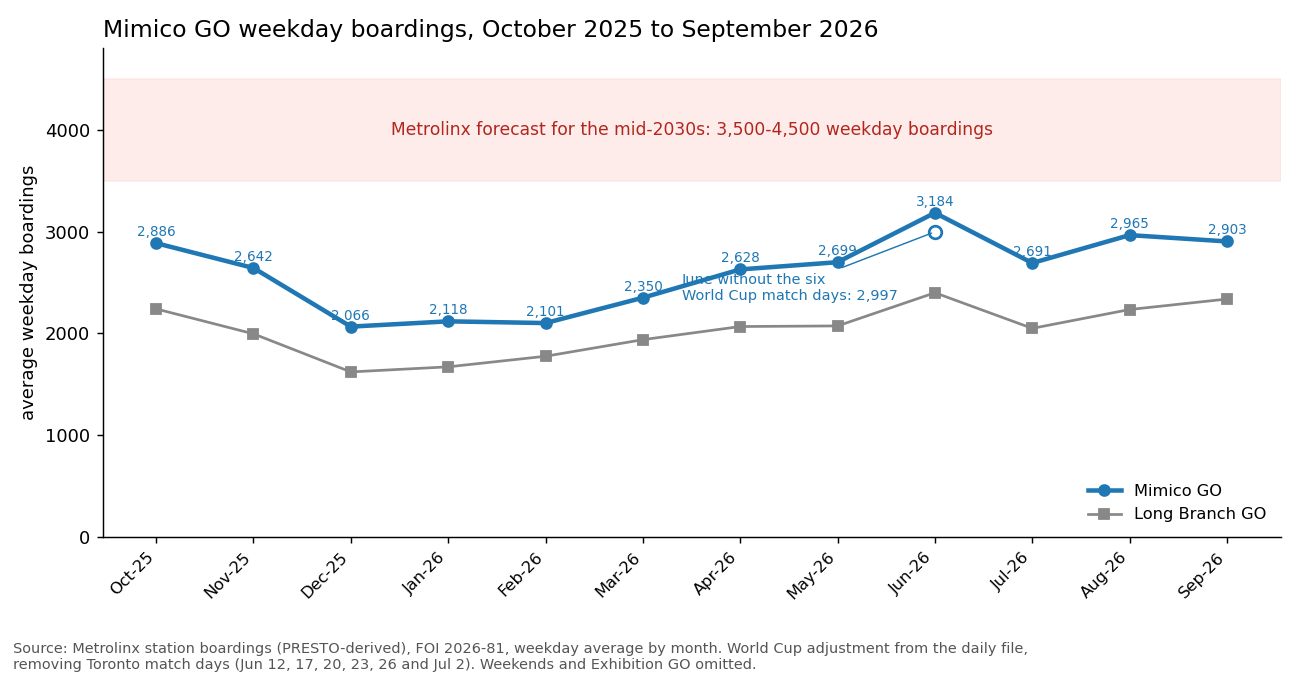
Mimico GO now averages about 2,900 boardings on a weekday, and about 3,000 in June even after taking out the six World Cup match days. In 2019 it was roughly 1,600: the station has nearly doubled its ridership with no elevators and half-hourly trains.
Metrolinx did provide its ridership forecast after we asked for it in one of our letters to its board. For the mid-2030s it is 3,500 to 4,500 weekday boardings. Mimico is already within a few hundred riders of it a decade early, before a single one of the about 10,000 new homes proposed around the station is occupied.
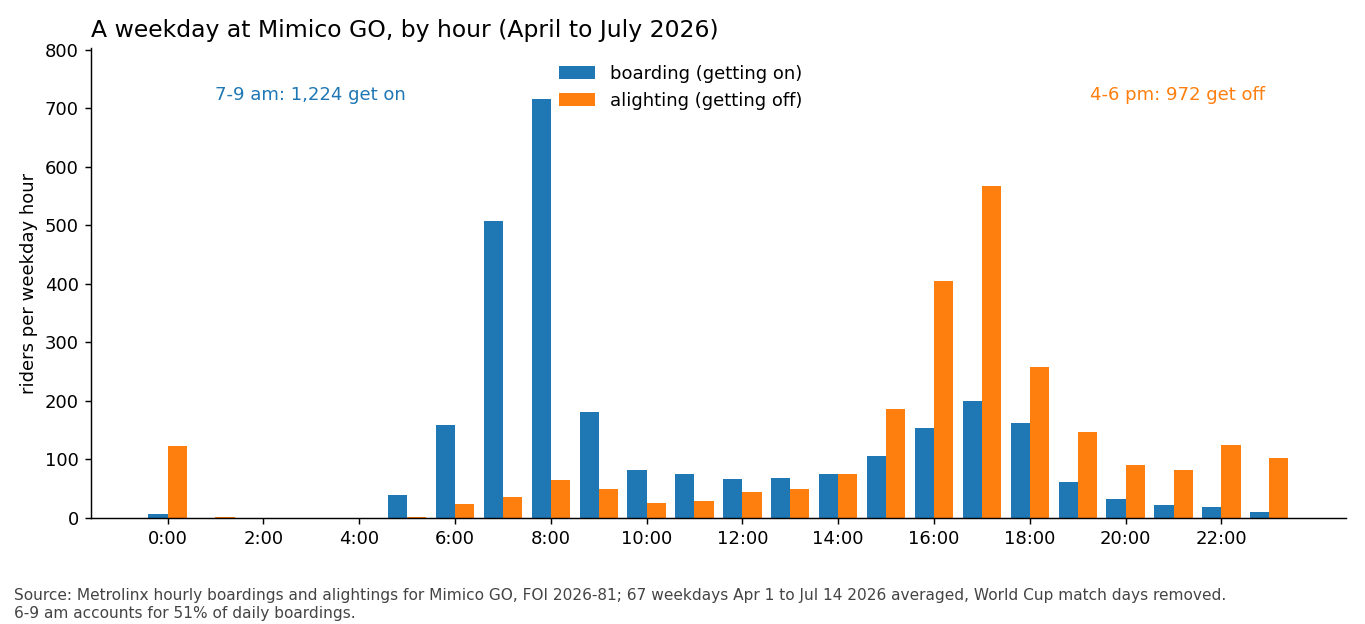
More than half of all boardings happen between 6 and 9 in the morning, about 700 people get on in the single hour after 8, and about 550 get off in the hour after 5.
How Mimico moves, by the numbers
This is not a full study, just a set of data points to help residents see how many people travel by each mode on a typical weekday. We added Billy Bishop because it was such a big topic this year: it moves about as many people a day as Mimico GO.
Reliable transit makes life more affordable
Transportation is the second-largest household expense in Canada after shelter. The average household spent $12,090 on it in 2023, 15.8 per cent of everything it spent, and about $10,300 of that went to its own vehicles. A household that can drop a second car, or go car-free, because transit is fast, reliable and takes them where they need to go, keeps that money. Homes without parking are cheaper to build: the builders’ own association told the City in 2021 that an underground space in downtown Toronto costs $80,000 to $100,000 to build.
More cars don’t mean more business
Main-street shops live on people who stop, not cars that pass through. In August 2016 the City put a pilot bike lane on 2.4 kilometres of Bloor Street between Shaw Street and Avenue Road, in place of a traffic lane and about 160 on-street parking spots, and University of Toronto researchers surveyed more than 3,000 visitors and over 500 merchants before and after.
Over half the merchants believed at least a quarter of their customers drove in. In fact, fewer than one in ten did. Nine in ten arrived on foot, by bike or by transit, and after that bike lane went in, customer counts and spending both went up.
More cars mean less safe streets
Toronto recorded 39 traffic deaths in 2025, 19 of them pedestrians, and a person hit at 30 km/h has roughly a nine in ten chance of living while at 50 km/h the risk of dying is about five times higher.
The limit on Mimico Avenue, with a school and two daycares, is 30 km/h. In 2025, about 13 per cent of westbound drivers were at or over the limit. By August and September this year it was 27 per cent, and the share doing 35 km/h or faster went from 2 to 8 per cent. The busiest months on record are also the fastest. On November 14, 2025, the province switched off every municipal speed camera in Ontario, including the one on Mimico Avenue.
Why more road never catches up
Traffic engineers call it induced demand: add road or parking capacity and the traffic grows to fill it, because trips that were not worth making in a jam become worth making on an empty road, until the road is no longer empty. The clearest study, by economists at the University of Toronto and the University of Pennsylvania, looked at every American metropolitan area over twenty years and found that a 10 per cent increase in road capacity produced a 10 per cent increase in driving. The reverse holds too: when road space is taken away, a share of the traffic simply disappears rather than flooding the next street. A garage works the same way as a lane, with one difference: a lane only invites the traffic, a garage that has to earn $60 million a year depends on it. For the idea in three minutes, watch TVO Today’s “What is induced demand?”
Mimico in 2036
Picture the barriers to GO transit gone, with a train every 15 minutes. A streetcar in its own right of way on Lake Shore, running straight into the Ontario Line subway at Exhibition, a true alternative to the GO train. Walking to the TTC or the GO station past shops that are busier because the sidewalk is. Every piece of that is already built somewhere in this city. Which brings us back to where this piece started:
Nobody has to give up the car that is already here.
-
But how many additional cars are we inviting?
-
And what do we invest in so that fewer people have to depend on cars?
What else?
Upcycling Community Hub!
Make treasure from your trash! We’ve all got items kicking around that could use a second life – join us for a series on upcycling, where we’ll create handmade journals and recycled paper out of paper waste, learn textile mending techniques, paint and refinish small furniture pieces, and even create our own musical instruments from found objects!
Saturdays, November 14 – December 5, 1:00 – 3:30 PM
At Lakeshore Arts (2422 Lake Shore Blvd. W.)

Diwali!
Back for our third year, celebrate Diwali with Lakeshore Arts with an afternoon of crafts and a free evening concert of Indian classical music and dance!
Whether you join us to learn about Diwali for the first time, or make LSA a part of your annual celebrations, all are welcome.
November 7 at Lakeshore Arts
Craft afternoon: 1:00 – 3:30 PM
Concert with TARANG: 6:30 – 8:30 PM (Doors at 6:30, concert at 7:00 PM)
At Lakeshore Arts (2422 Lake Shore Blvd. W.)

Toes for Dance
This weekend, Toes for Dance presents Premiere Dance Presentations, featuring KINAJ and Atri Nundy, supported by Lakeshore Arts!
Saturday, November 7, 2026 at 8:00 PM, followed by a post-show reception.
Sunday, November 8, 2026 at 3:00 PM, followed by a post-show Artist Talk/Q&A.
At Assembly Hall (1 Colonel Samuel Smith Park Dr, Etobicoke)
Tickets available here!

Garlic Workshop Series
Sunday, November 8 at 3:30 PM
This session will focus on planting organic garlic and preparing our beds for winter! We will be meeting to plant next year’s garlic crop courtesy of Toronto Garlic Festival and Friends of Allan Gardens. At Father John Redmond (Western side behind the school, near the track). Email gardenslakeshore@gmail.com to attend.

See you around, Mimico!
Sources regarding traffic / transit
-
Metrolinx, Mimico GO hourly boardings and alightings, January to July 2026, and monthly averages October 2025 to September 2026, released under freedom of information request 2026-81; Metrolinx letter to the MRA, October 30, 2026 (forecast attachment); Metrolinx letter, August 2026 (bridge rationale).
-
City of Toronto open data, Safety Zone Watch Your Speed Program monthly summary (signs at 30 Mimico Ave, 278 Royal York Rd, 148 Stanley Ave).
-
TTC, Weekday boardings and service information for surface routes, October 2025, and the Fall 2019-2024 surface route statistics.
-
City of Toronto, Lake Shore Boulevard West cycle track counter, 2026, and Bloor Street bicycle counts.
-
City of Toronto, Christie’s Planning Study (4,422 parking spaces, 7,504 units).
-
CP24, $200 million Ontario Place parking garage; The Trillium, garage revenue projection; City of Toronto, Ontario Place transportation supplementary report, January 2025 (2032 forecast from the proponent’s traffic impact assessment); Impact Assessment Agency of Canada, Ontario Place Spa Complex and Underground Parking Garage Project (1,900 spaces, decision September 12, 2024).
-
City of Mississauga, Lakeview Village Transportation Consideration Study, August 2019 (2041 forecast: 3,231 a.m. and 4,355 p.m. peak-hour auto-driver trips for about 9,700 units at a 60 per cent auto-driver share; 1.96 persons per unit); O. Reg. 91/23 (cap of 16,000 dwelling units); CBC, province doubles size of Mississauga development with MZO, May 2023; The Pointer, May 16, 2023.
-
Metrolinx, GO Expansion Update: Mimico and Long Branch, community briefing deck, June 13, 2018 (RFQ December 2017, RFP April 2018, two tunnels with elevators at each station, construction 2020 to 2023); Metrolinx, Metrolinx partners with developer on new Mimico GO, October 22, 2018; Metrolinx, Long Branch GO Station Improvements; Metrolinx, Ontario Line, Exhibition Station.
-
Metrolinx, 2013 AODA status report and 2024 AODA status report; Metrolinx technical standards, station design, October 2025.
-
MRA inventory of live Mimico applications, compiled from City staff reports and the Application Information Centre, October 2026; City of Toronto open data, mid-block traffic counts, Park Lawn Road between Lake Shore and the Gardiner ramp (12,461 vehicles a day, April 2012; 29,838, April 2025).
-
Statistics Canada, Survey of Household Spending, 2023, released May 21, 2025 (transportation $12,090, 15.8 per cent of consumption, second after shelter; public transportation $1,799, the remainder private); Residential Construction Council of Ontario, letter to Planning and Housing Committee, item PH29.3, November 24, 2021 ($80,000 to $100,000 per below-grade space, up to $165,000).
-
Duranton and Turner, “The Fundamental Law of Road Congestion”, American Economic Review, 2011; Cairns, Atkins and Goodwin, “Disappearing traffic?”, 2002.
-
Toronto Centre for Active Transportation and University of Toronto, Economic Impact Study of Bike Lanes in Toronto’s Bloor Annex and Korea Town Neighbourhoods.
-
Todd Litman, Valuing Transit Service Quality Improvements, Victoria Transport Policy Institute, April 2026 (US DOT values: in-vehicle time at 50 per cent of the wage rate, waiting, walking and transfer time at 100 per cent); Transportation Research Board, Transit Capacity and Quality of Service Manual, 3rd ed.
-
Global News, speed camera ban comes into effect, November 14, 2025; Toronto Newswire, speed cameras moved to Mimico (Mimico Ave. west of Station Rd.).
-
CP24, 2025 Toronto traffic deaths; SWOV, collision speed and pedestrian fatality risk.